The service
Bioenergetic model for seed pre-fattening of Manila clam (Ruditapes philippinarum) – ended
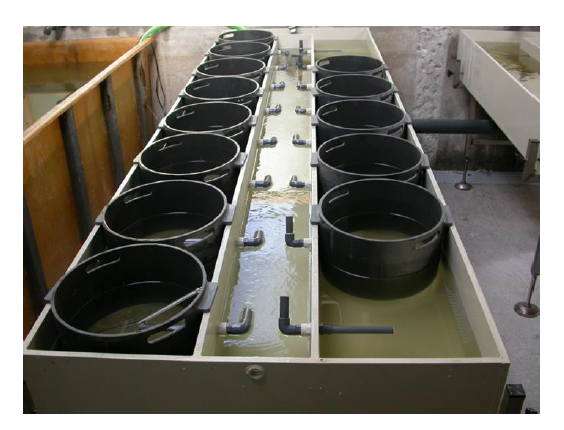
Manila clam (Ruditapes philippinarum) farming in the lagoons and fish valleys of the Veneto region represents one of the most economically significant aquaculture activities in the Northern Adriatic. A critical step in the production process is the pre-fattening phase: hatchery-produced seed, at an average length of approximately 1 mm, is placed in upward-flow systems known as "upwelling" units and must reach 4 mm before being transferred to lower-energy systems — valley-based flupsy units or suspended lanterns in the lagoon — where pre-fattening continues until approximately 15 mm. Management of upwelling units (seeding density and water flow rate) is still largely empirical, with no predictive tools available to optimise yield.
Bluefarm's role
Veneto Agricoltura (Veneto Region's Agency for Innovation in the Primary Sector) directly commissioned Bluefarm to provide data analysis and develop a predictive model for Manila clam seed pre-fattening in fish valleys and lagoonal environments.
The work was structured in two phases:
1. Experimental plan
Veneto Agricoltura conducted a structured experimental programme at the Centro Ittico Sperimentale di Valle Bonello (Rovigo), systematically varying the two main controllable parameters of the upwelling system — biomass density and water flow rate — across two distinct seasons: autumn 2022 (October–December) and spring 2023 (April–June). Trials were started with seed ranging from 1.5 to 2.5 mm in length, at initial densities of approximately 100,000, 200,000 and 300,000 individuals per upwelling unit, and at two flow rates (high flow: 20 ml cm⁻² min⁻¹; low flow: 10 ml cm⁻² min⁻¹). Environmental variables — water temperature, dissolved oxygen and chlorophyll a concentration — were monitored daily, and biometric parameters (weight and length) were sampled fortnightly.
2. Model development
Bluefarm developed, in the R programming environment, a dynamic bioenergetic model for simulating individual growth of Manila clam during the first pre-fattening stage (1–4 mm). The model is based on a system of ordinary differential equations (ODEs) describing the temporal evolution of the individual energy budget — the difference between anabolism (energy assimilated through filtration) and catabolism (energy consumed for vital functions), known as Scope for Growth — and of water quality within the upwelling unit.
A key novelty of the model with respect to existing literature is the introduction of an exponential function modulating the individual filtration rate as a function of biomass density and upward water flow velocity. This function captures the observation that, as density increases, clams tend to aggregate and reduce their individual filtration rate, and that this effect is partially counteracted by higher flow rates — which increase turbulence and reduce inter-individual contact. The model produces predictions of weight, length and total biomass growth, as well as the percentage of individuals exceeding the 4 mm threshold.
The model was applied to experimental data from both seasons, achieving good agreement with observations in 11 out of 12 trials. The residual case (upper sieve level in the double-sieve spring trial) highlighted possible selective depletion of assimilable phytoplankton by the lower clam layer, pointing to a direction for further research.
Results indicate that densities of 100–200 individuals/cm² at high flow (~20 ml min⁻¹ cm⁻²) optimise growth in spring, a season when — despite lower chlorophyll a concentrations compared to autumn — growth rates and survival were significantly better, suggesting higher energy availability linked to the seasonal composition of the seston.