

The service
PERCIPONIE – Development of Percid Culture in Aquaponics – completed
The PERCIPONIE project, funded by the EU Interreg V-A Grande Région Programme, promoted the development of percid fish farming in aquaponic systems within the cross-border area of the European Greater Region (Belgium, France, Luxembourg, Germany, Switzerland). The project involved research centres and pilot facilities in Belgium and France, with the aim of assessing the technical, environmental and economic feasibility of integrated fish and vegetable aquaponic productions.
Bluefarm's role
Bluefarm participated in the PERCIPONIE project as a subcontractor of the University of Liège (UGeRAA — Unité de Gestion des Ressources Aquatiques et Aquaculture), which issued a Call for Tender within the project framework. Bluefarm's work consisted in the design and application of Life Cycle Assessment (LCA) and Life Cycle Costing (LCC) analyses to two pilot aquaponic systems, using a cradle-to-gate approach over an annual production time-span.
The two systems analysed were:
SYS1 — CERER-Pisciculture, Strée (Belgium) A pilot indoor aquaponic facility comprising 6 rearing tanks, a biofilter and a drum filter for mechanical filtration. Hydroponic beds are arranged on 3-level shelves lit by artificial LED lighting, with a total crop surface of 50 m². Two production scenarios were analysed: the current setup with pikeperch (Sander lucioperca, 211 kg/year) and lettuce (Lactuca sativa, 1,194 kg/year), and an alternative scenario with tilapia (Oreochromis niloticus, 553 kg/year) and mixed vegetables (1,680 kg/year). For both scenarios the life cycle inventory was built entirely on primary data, including data collected during field surveys conducted by Bluefarm personnel in July 2022.
SYS2 — La Ferme Aquaponique de l'Abbaye, Chaumousey (France) An aquaponic facility housed in a renovated storehouse with transparent polycarbonate roof and walls to maximise natural light, using rainwater for system refill. The system comprises 5 independent production lines covering a total growing surface of 500 m², with an integrated production of carp and mixed vegetables.
The environmental analysis was performed using the CML-IA baseline method (v3.01/World 2000) for the impact categories: Abiotic Depletion (AD), Global Warming Potential (GWP), Acidification (AC) and Eutrophication (EU), complemented by Cumulative Exergy Demand (CExD) and Water Scarcity (WSI) methods. All calculations were performed in SimaPro 9.3.0.3, using Ecoinvent® v3.8 and Agribalyse® databases.
Results showed that energy consumption is the dominant source of environmental and economic burden in both systems, with a major influence on carbon footprint (SYS1: 10.6 kg CO₂ eq/kg vegetables; SYS2: 14.9 kg CO₂ eq/kg vegetables) and production costs. The alternative tilapia scenario performed better both environmentally — reducing carbon emissions by 2.2 kg CO₂ eq compared to SYS1 — and economically, cutting production costs by approximately 33% (from €14.35 to €9.64 per kg of vegetables), confirming tilapia as a promising candidate species for aquaponic production scale-up.
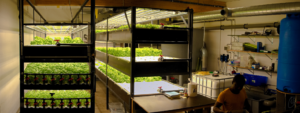
Overview of the CERER-Pisciculture pilot aquaponic system in Strée (SYS1)
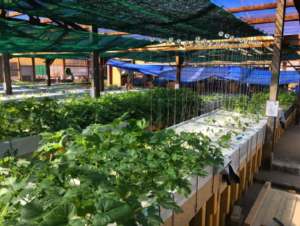
Overview of the Ferme Aquaponique de l’Abbaye in Chaumousey (SYS2).
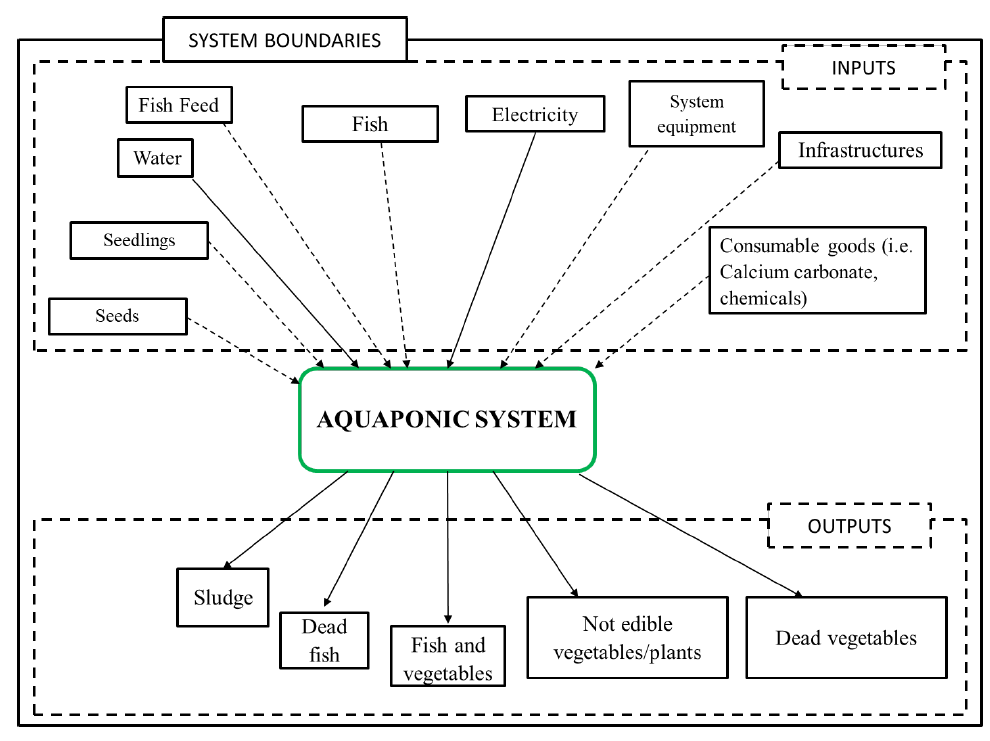
System boundaries defined for both SYS1 (Aquaponic system in Strée) and SYS2 (La Ferme Aquaponique de l’Abbaye). Dotted arrows represent the transportation.
For more information, visit the official project website: perciponie.eu