

The service
AdriAquaNet – Enhancing Innovation and Sustainability in Adriatic Aquaculture – ended
The AdriAquaNet project, funded by the EU Interreg V-A Italy-Croatia 2014-2020 Programme, was coordinated by the University of Udine and brought together 11 partners including research institutions, industry companies and trade associations, distributed across Italy and Croatia. The project community involved approximately 100 experts, with the aim of strengthening innovation and sustainability in Adriatic aquaculture, transferring advanced knowledge and new technologies throughout the entire supply chain, from the management of production plants to the processed products market.
The project was structured around three main themes: the optimisation of feed for farmed fish and energy saving in production plants; the development of new vaccines and therapies for health management in fish farms; the development and commercialisation of new fish products. The project started on 1 January 2019 and ended on 30 June 2022.
Role of Bluefarm
Bluefarm participated in the AdriAquaNet project as an external service provider for the University of Udine, starting from November 2019.
Bluefarm's contribution was structured around two main activities:
1. Development of a web-based interface for growth simulation
Bluefarm made available to the project's stakeholders, through a web-based service, a dynamic model for simulating the growth of sea bream and sea bass in cage farming. The user-friendly interface developed allows any fish farmer to estimate the growth of their fish stock by entering time series of water temperature and feed ration, as well as diet composition. The model, freely accessible through Bluefarm's website, allows users to visualise and download results both in graphic form and as a numerical matrix.
2. Simulation of the environmental impact of pilot farms
Bluefarm applied the integrated FiCIM model to simulate the sediment impact of the two Croatian pilot farms involved in the project: Friskina and Orada. The simulations compared the depositional footprint of the innovative feeds developed within the AdriAquaNet project against traditional commercial feeds, assessing the organic matter fluxes (C, N, P) released by the farms and the consequent expected changes in benthic community indices.
To make these simulations possible, Bluefarm carried out two experimental current measurement campaigns in situ, which were not initially included in the activity plan, deploying a current meter at the two pilot sites (Friskina: August–November 2020; Orada: July–August 2021). Water temperature data, where not available from in situ measurements, were supplemented with Copernicus Sea Surface Temperature satellite data.
The results showed that the innovative AAN feeds produce a smaller depositional footprint compared to commercial feeds, particularly at the Orada site, which was characterised by higher stocking densities.
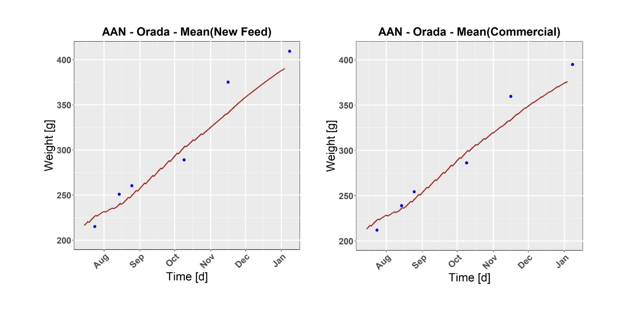
Model results, Orada Site. Model growth predictions (red line) and comparison with experimental data collected in situ. Simulations and data refer to individuals fed with innovative AAN feeds (left figure) and commercial feeds (right figure), over the period 13 July 2020 - 2 January 2021.
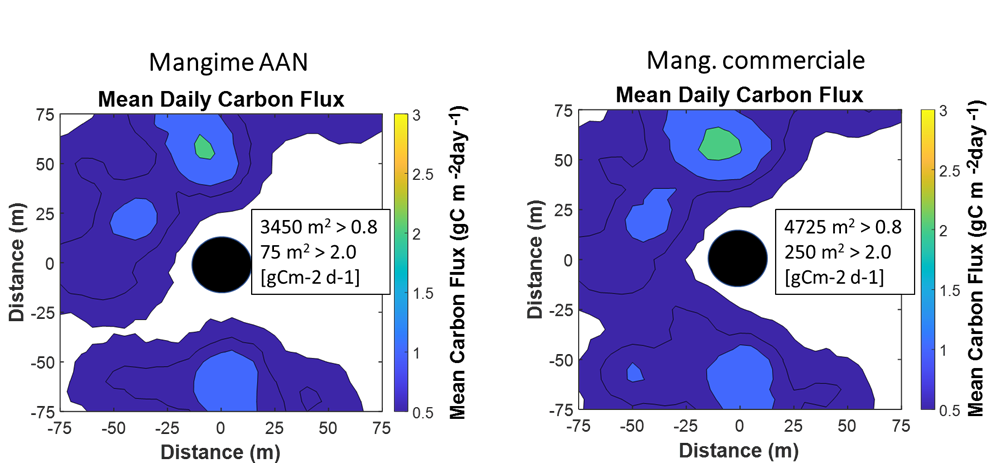
Simulated depositional footprints at the Orada experimental site. The fish cage, at the centre of the figures, is represented in black. The panels show summary indices related to the footprints. The simulation considered the stocking density used in the trials, equal to ∼ 41 ind/m³
Dissemination Events
As part of the AdriAquaNet project, Bluefarm actively participated in events aimed at transferring results to sector stakeholders, presenting the modelling activities carried out within the project:
- Ostuni, May 2021 – Presentation of modelling activity results at the project event dedicated to knowledge transfer to aquaculture sector operators.
- Padova, 2021 – Presentation of modelling activities at the project event.
- Madeira, October 2021 – Presentation of a poster contribution at the international congress of the European Aquaculture Society (EAS), on the environmental impact simulations carried out at the Friskina pilot site.
- Ostuni, May 2022 – Presentation of final results at the project's closing professional training day, dedicated to improving sustainability in mariculture.
- Ravenna, October 2022 – Presentation of a scientific contribution at the 2022 edition of the international congress of the European Aquaculture Society (EAS).
For more information visit the official website of the project!